All of Kathmandu and Lalitpur is filled with small stores and shops, many of which are art-related. They sell canvases, often of very high quality and created by local artists. But these places are just retail outlets. Where do the artworks actually come from? Who creates them, and who even teaches the artists how to do this?
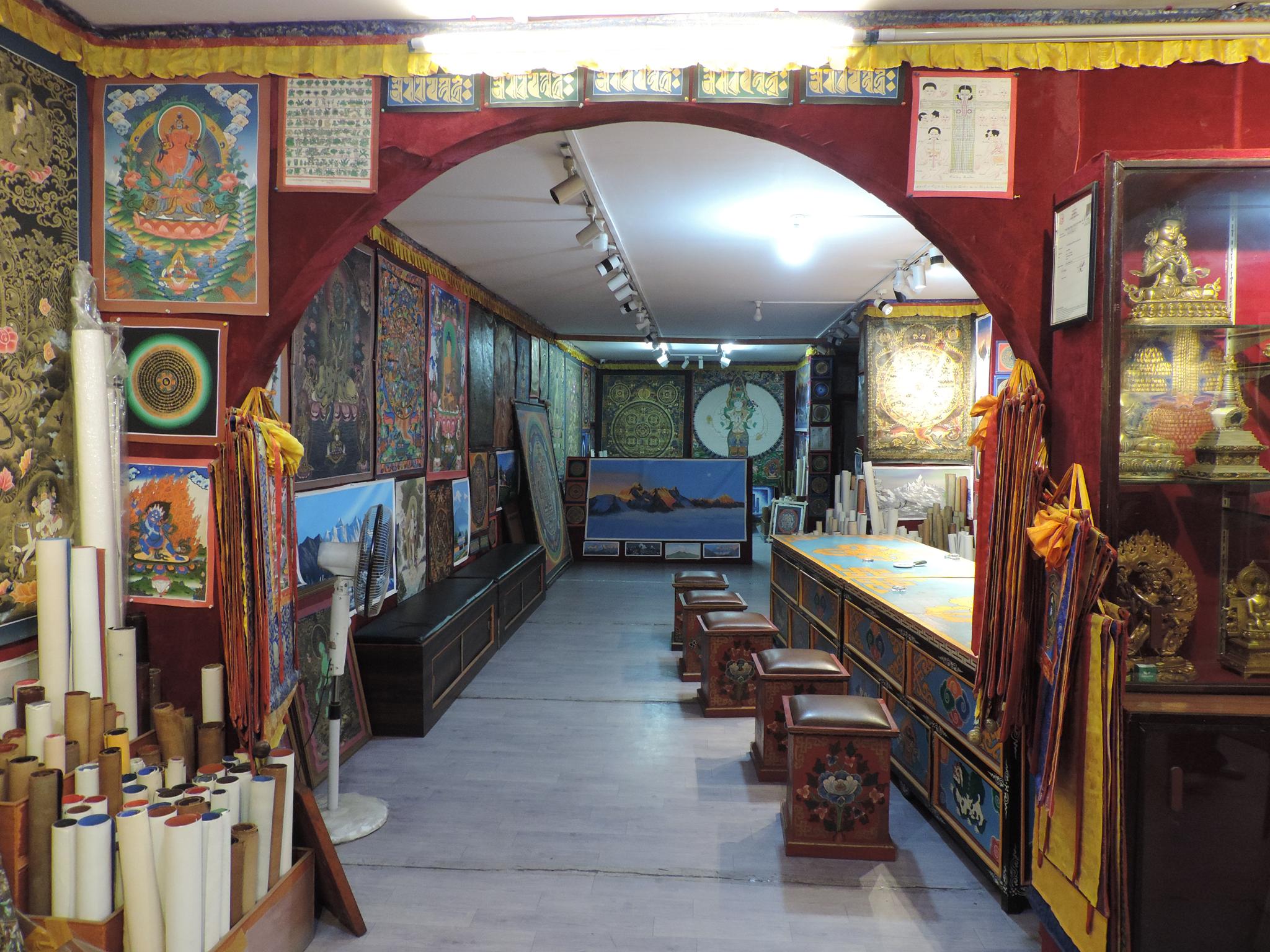
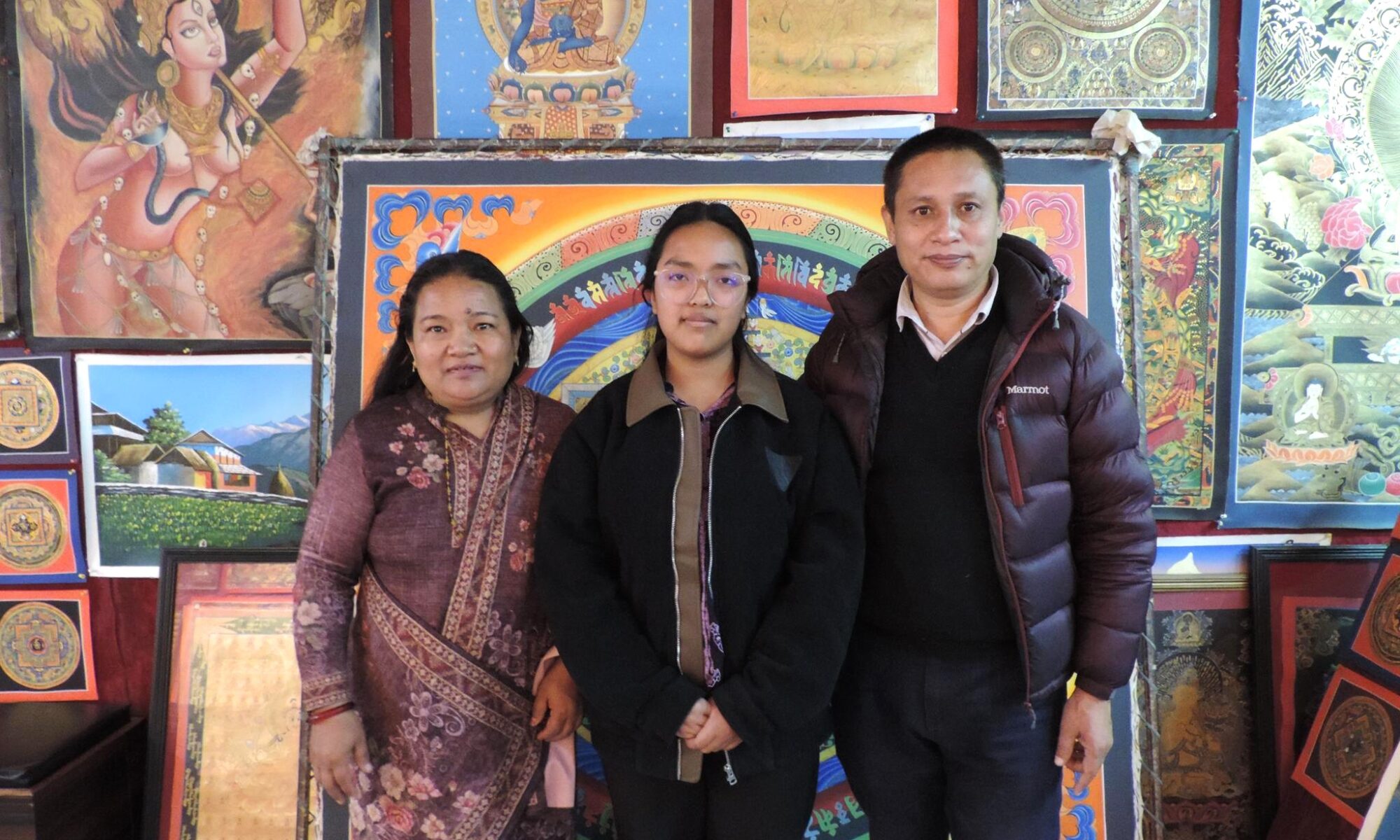
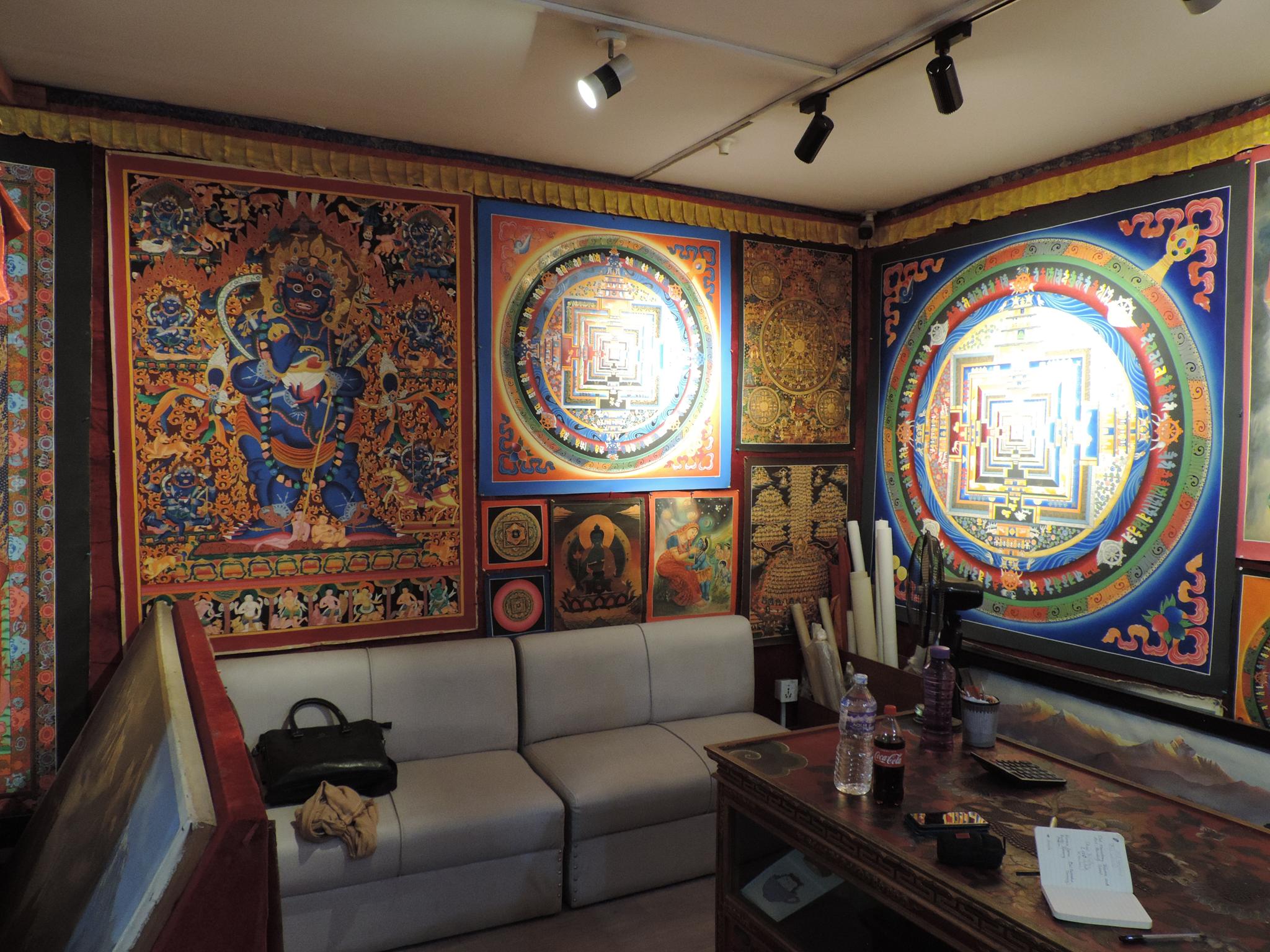
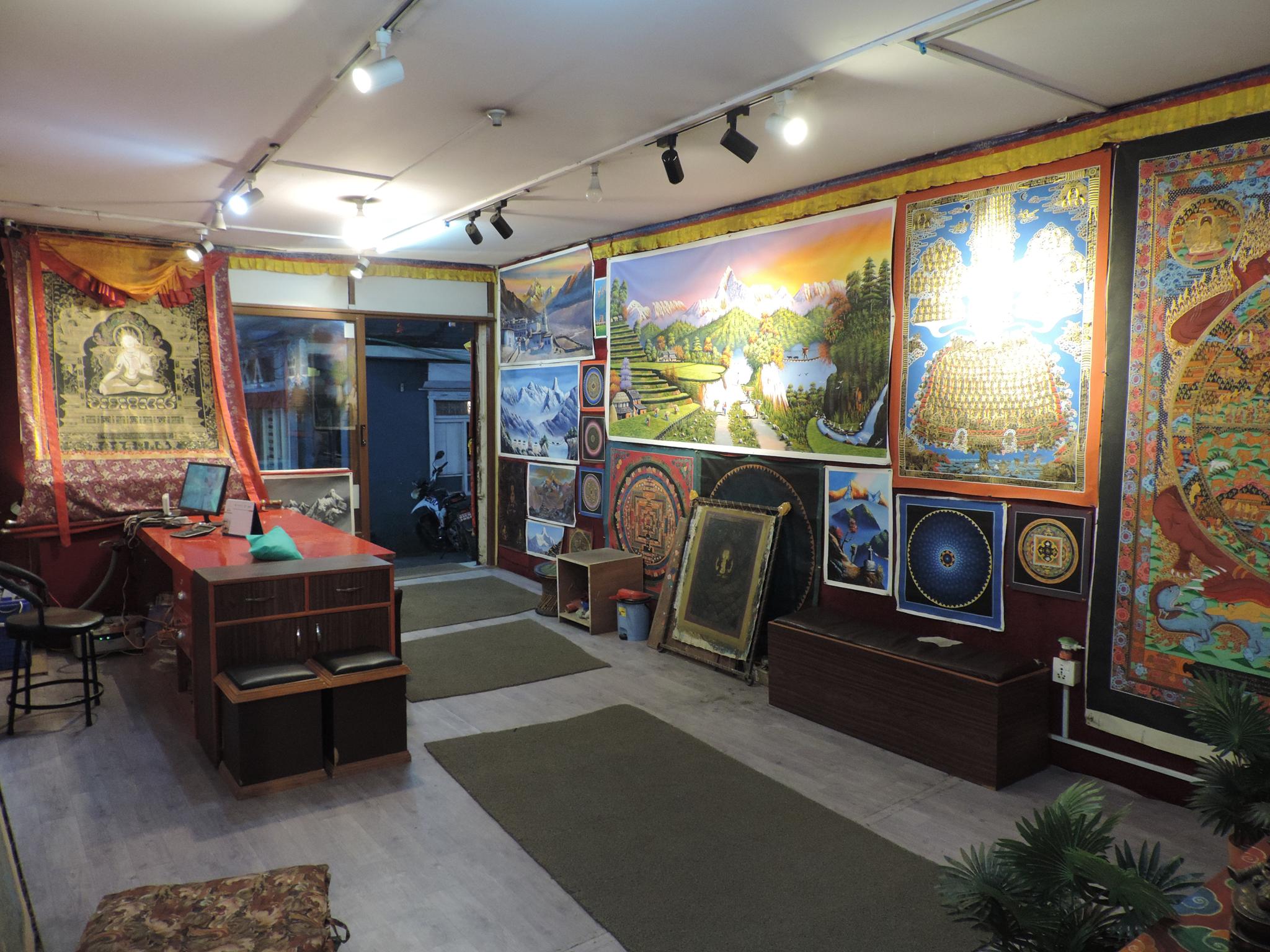
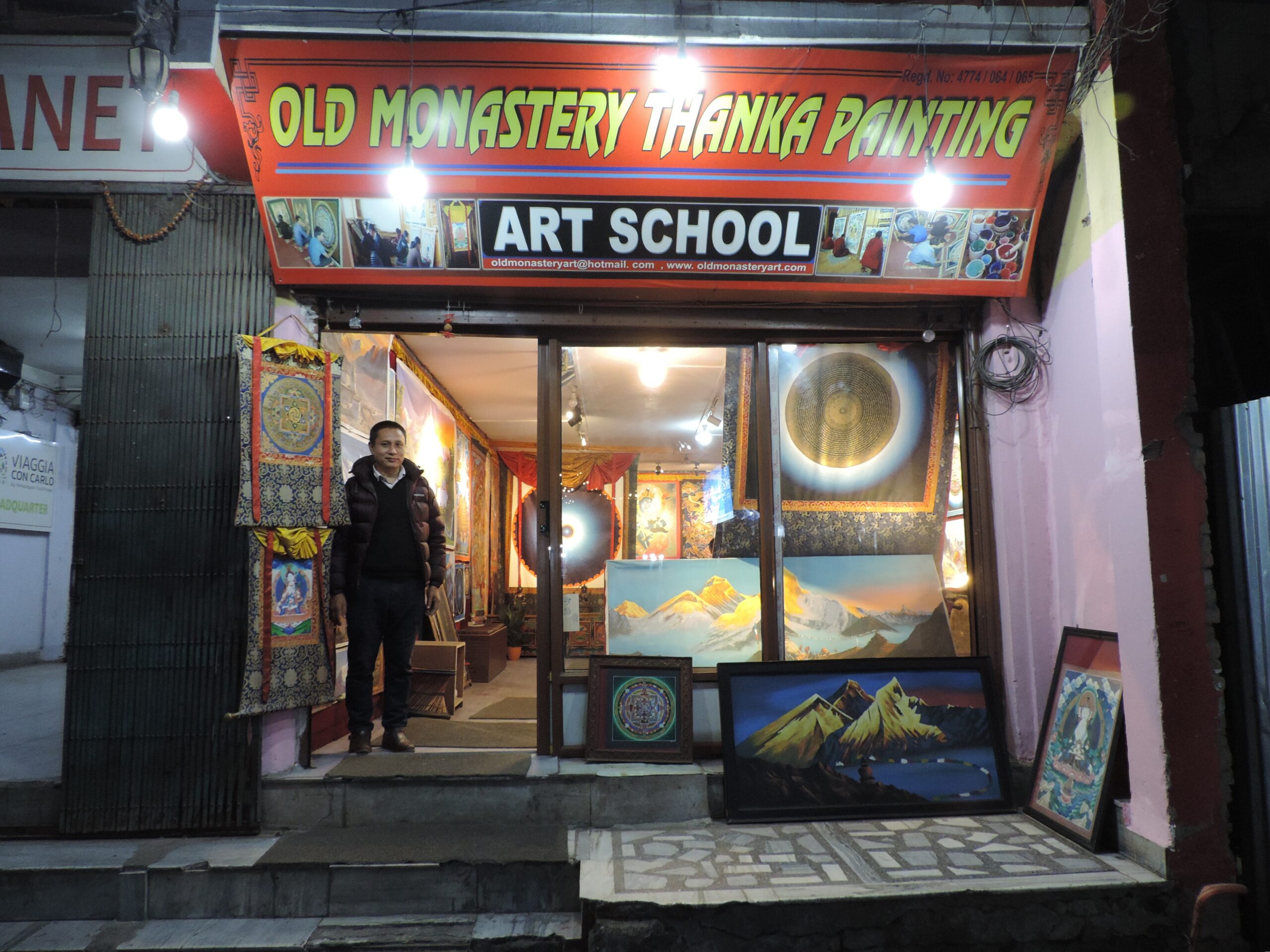
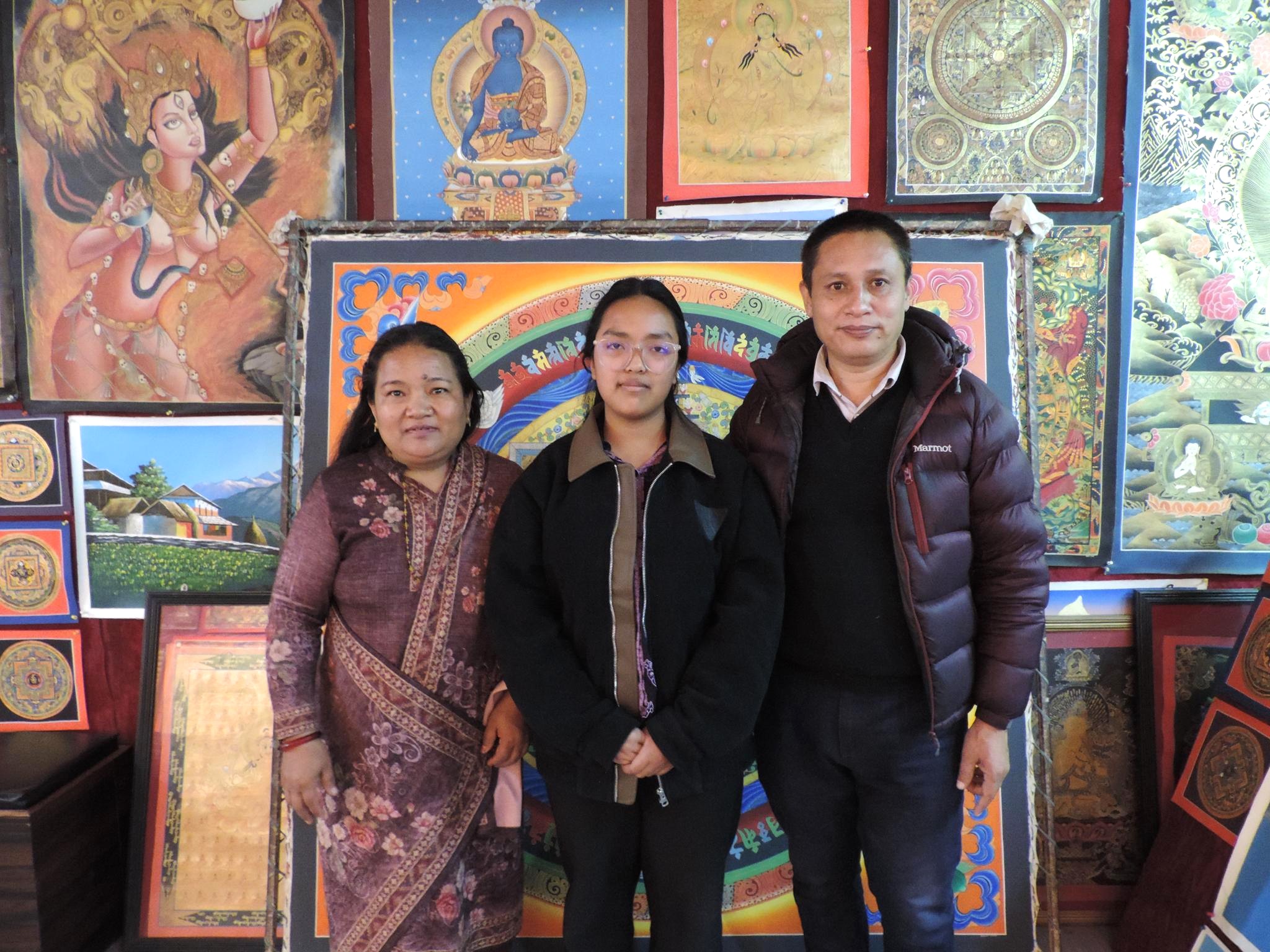
We visited the artist and art teacher KUMAR LAMA at his art school OLD MONASTERY THANKA AND ART PAINTING SCHOOL, and spoke with him about his creative space and the art presented. Currently 45 teachers work there and more than 100 students are taking part at the program. Also joining the interview was KUSFU TAMANG, who is an artist herself but also works at the art enterprise and is his daughter. We spoke with both in an interview about the school, the artworks and the background behind. This space is an art education program that has been in operation for many generations. If you want to listen, click on the podcast below. If you prefer to read, the written interview follows below. Inbetween filled with great artworks from the school and gallery.
At the moment we are in Nepal, in Kathmandu district of Thamil. And I’m sitting now in the OLD MONASTERY THANKA AND ART PAINTING SCHOOL. It’s a wonderful place filled with great paintings and one part of the building is a gallery. But it’s also an art school and they have more than 100 students and more than 45 teachers. And I’m going to talk now to the owner. He’s a master artist and also runs the place. His name is DAL BAHADUR TAMANG, but he is working as an artist with the name KUMAR LAMA. And next to him is sitting his daughter KUSFU TAMANG, she’s also involved in the gallery, but also an art student. They will tell us now more about the place and about this special kind of art. KUMAR, when did you start with this place?
Actually, this place was established in 2007, which means it has been running for almost 17 or 18 years now. It has become quite well known, and many people come here to learn about Tibetan Buddhist art. I have been teaching in this way for the past 15 to 18 years. Over time, I have had many students here, more than a hundred in total. We also have more than 45 teachers working in different places across Nepal. Some of our workshops are located in other areas such as Farping, Patan, and Bhaktapur. These are three main locations where our work is still ongoing. The artworks are produced there and then brought here to Thamel, where we display them. Some of them are sold to tourists, and the money we collect from selling the thangkas is used to support the school. That’s essentially what I do here.
You said this word „Thanka“. I think maybe many people don’t know what it is, can you explain what is a Thanka?
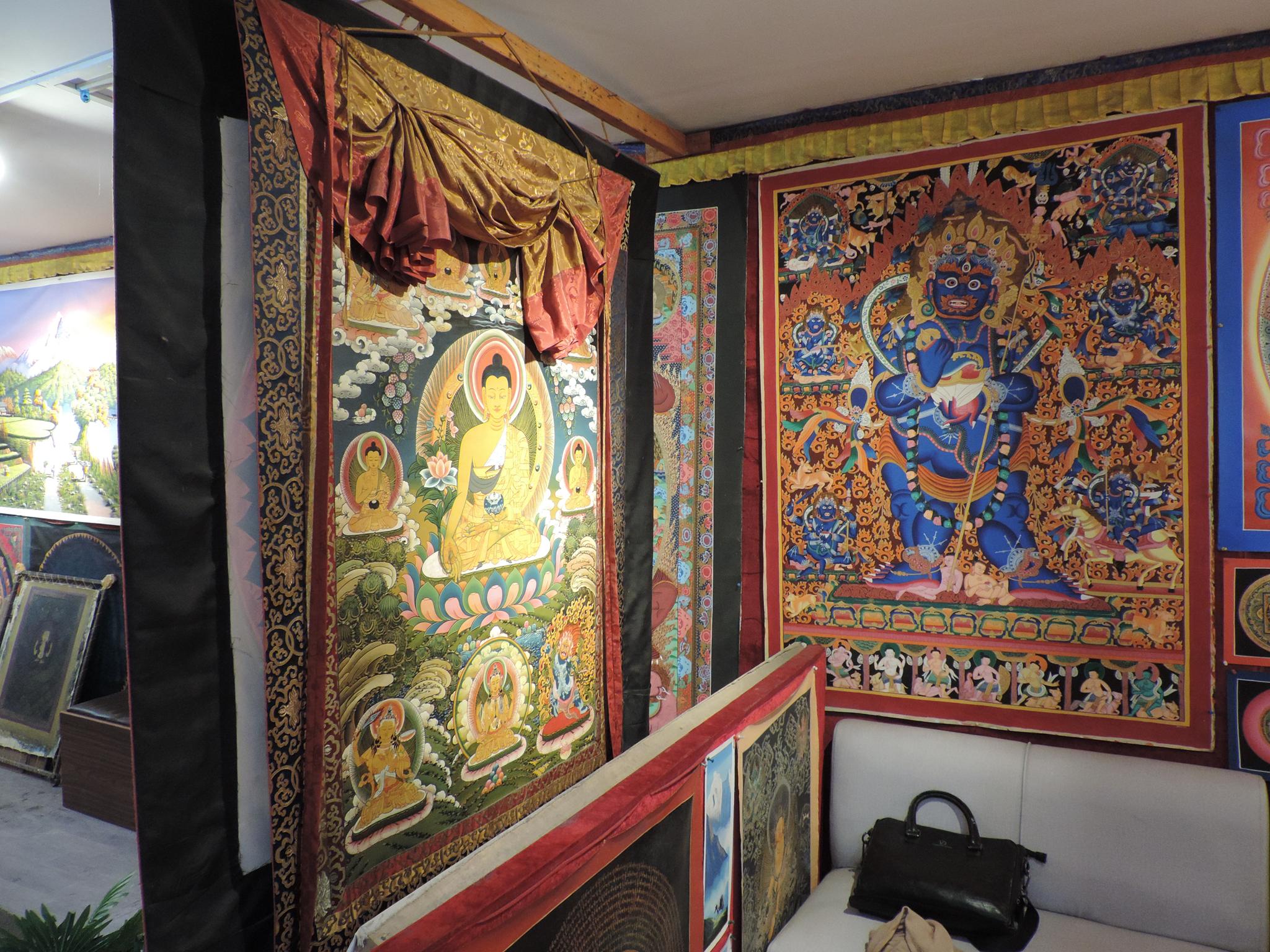
Actually, the Thanka is one of the Tibetan art forms. In the Tibetan language, “than” refers to something related to Buddhism, and “ka” means something that is painted on cotton cloth. That is why it is called „Thanka“ or „Thangka“ painting. Basically, there are five main types of thangka designs. These include mandalas, the Wheel of Life, Kalachakra mandalas, and individual figures. There are also many other forms that we can create and paint. There is really no limit, because artists can always create much more.
So you are an artist yourself? When did you start doing art?
I have been studying art since I was about thirteen or fourteen years old. I started learning as a child because this is my family tradition. Art has been a part of my life all along, and it is the work of my family. We come from an artist family. All of our family members are involved in art, and we have been working with paintings for a very long time.
How did you learn all of that? From your father, and he from his father?
Yes, it comes from my father. And my father learned from his father, and so on, from grandfathers and great-grandfathers. It is a very long tradition. My father taught me, and now I teach my daughter, and she can teach other people in turn.
All around us, there are many colorful paintings. How do you create them? Do you use pencils and oil paints, or what kind of materials do you use?
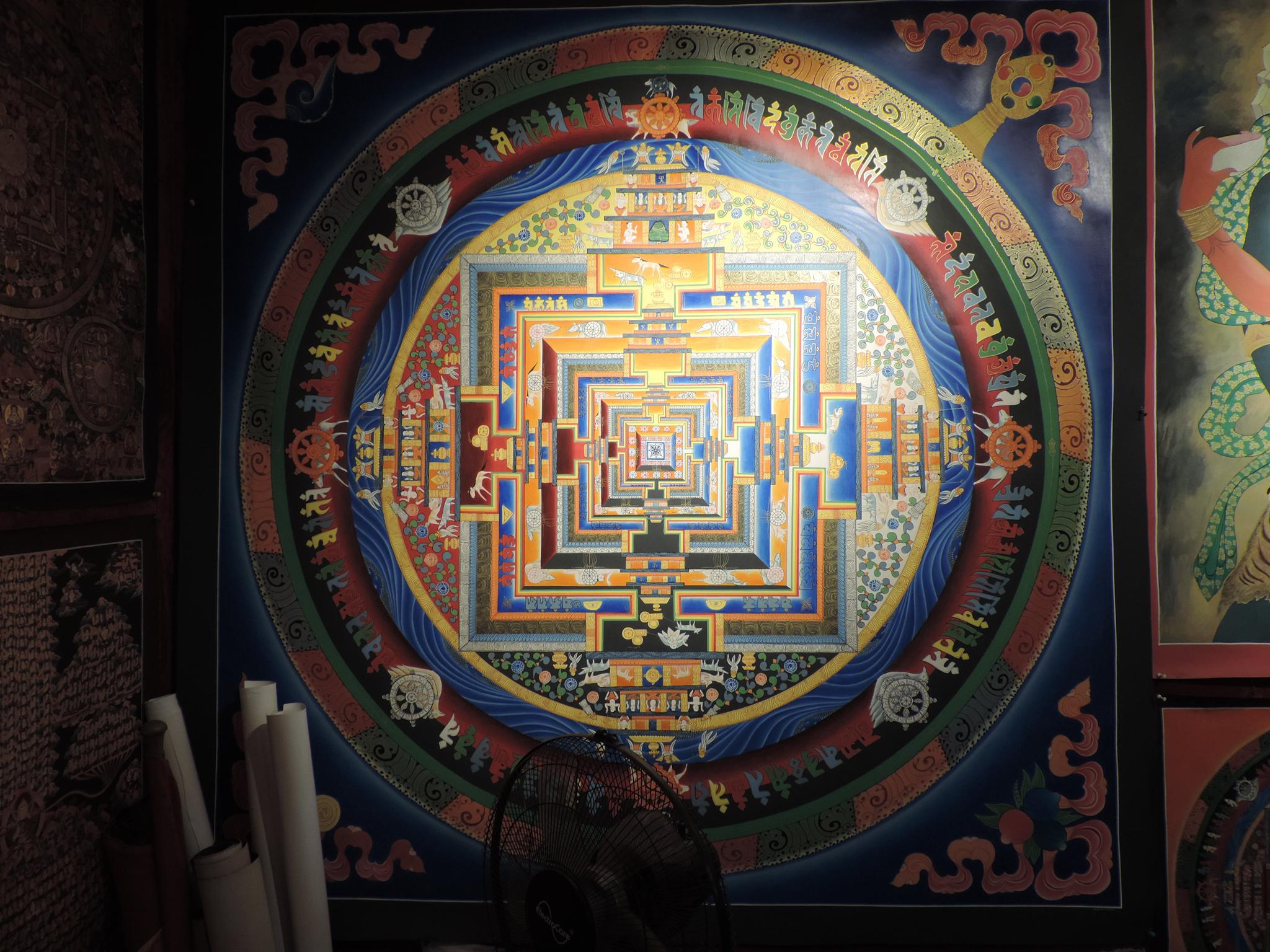
Sometimes we use acrylic paints for learning and teaching purposes. However, the highest quality thangka paintings are made using mineral pigments. They are painted with a single hair of a yak brush, which takes a long time. Even a small mandala the size of an A4 sheet can take a month to complete because every tiny detail is painted carefully with a single yak hair. A mandala is usually round. It has a circular structure, which is very geometric. A mandala represents the universe, and at the very center, you can see nirvana, often depicted as a small point called a lotus. Mandalas are often used for meditation. All of the works you see here follow this tradition.
These works are not only colorful creations, they also have a deep connection to religion, like Buddhism and Hinduism.
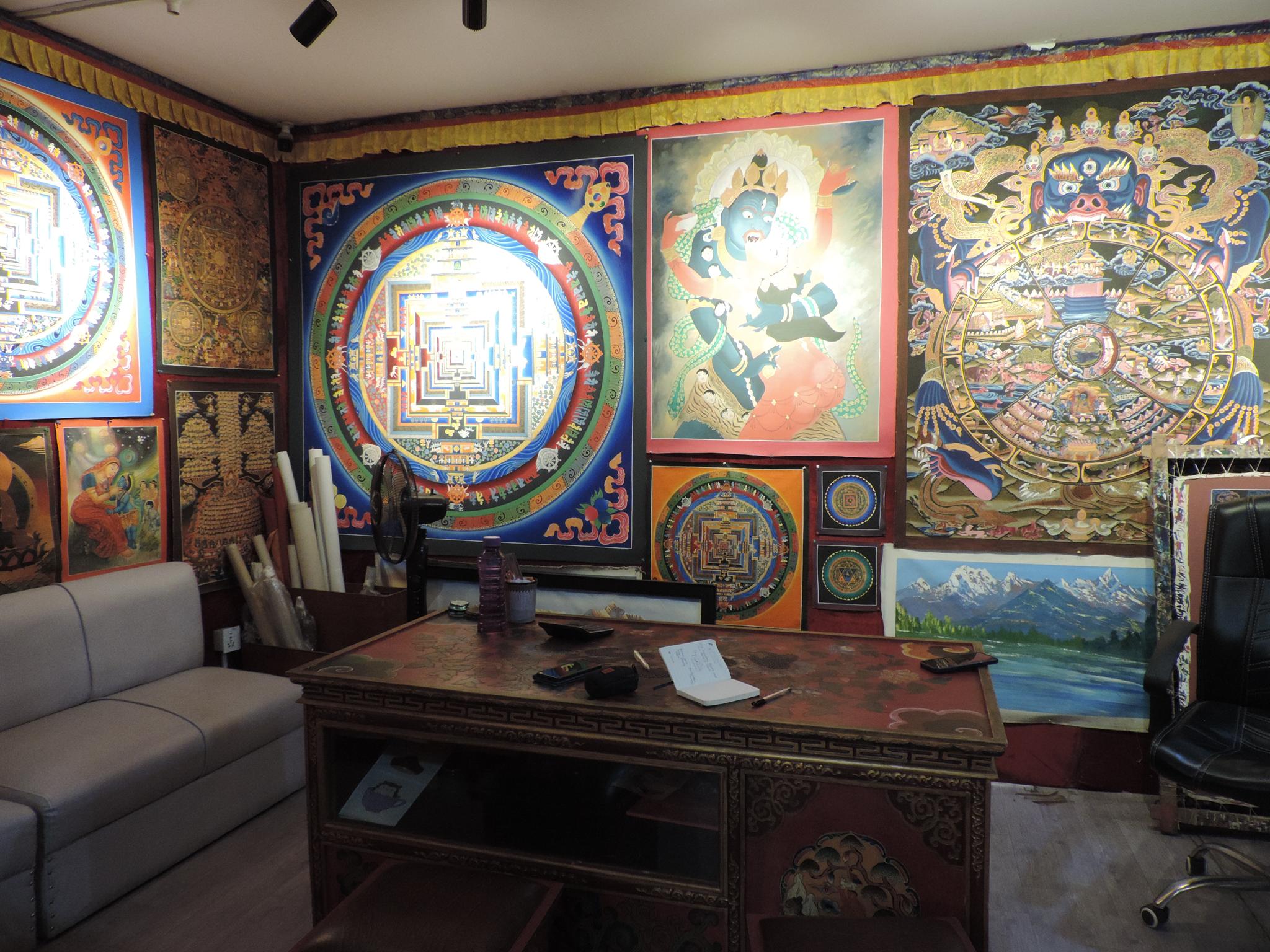
Buddhism and Hinduism, yeah. It’s a big connection. We show the ancient gods and traditional motifs, but also combined with modern techniques. The ancient gods that we follow, the ancient gods like that. Or this mandala circle. This is like a circle of life. It’s a samsara.
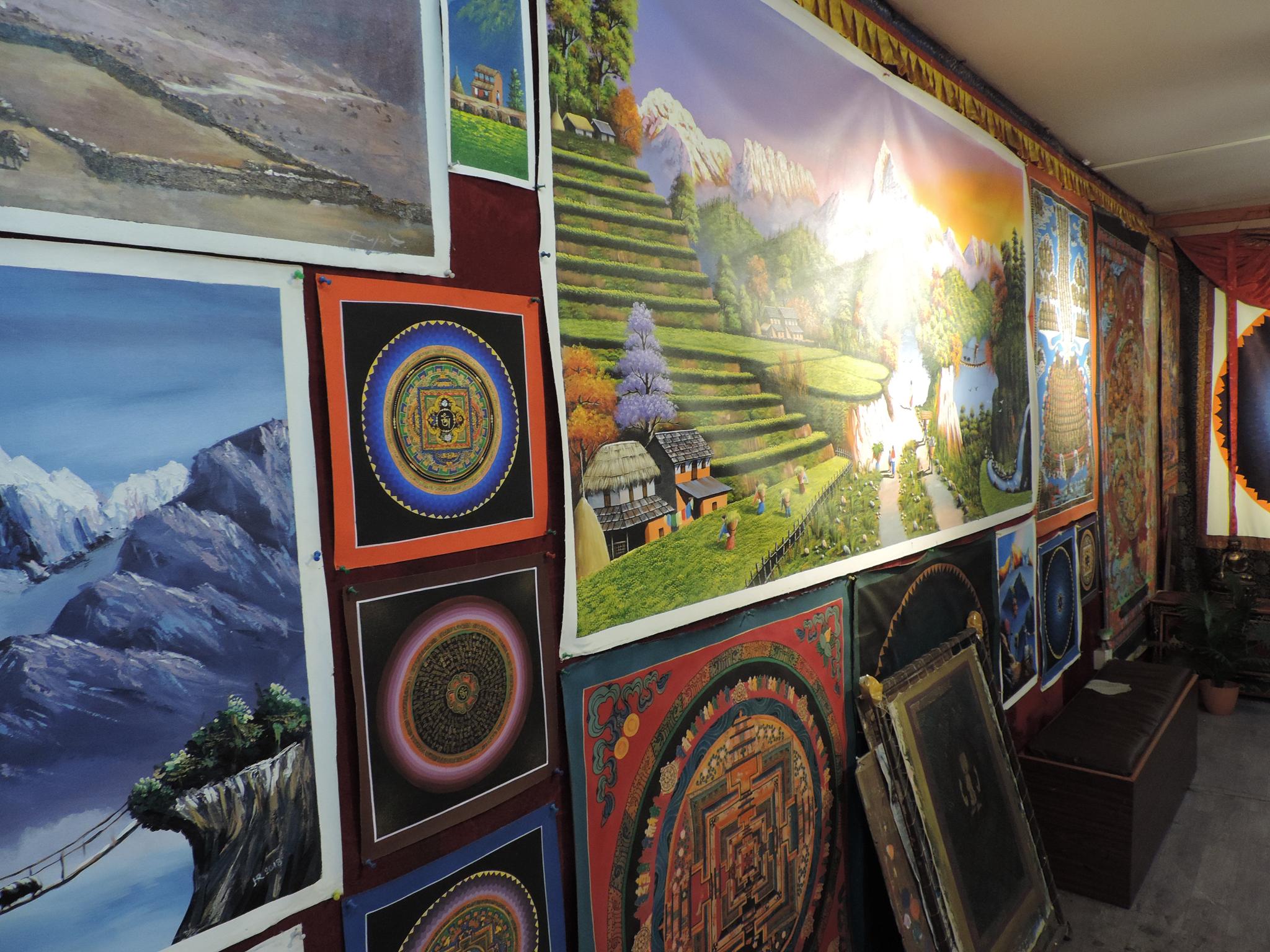
And there are a lot of little sceneries. So actually there are a several paintings inside one painting.
Yeah, it’s very detailed. There are a lot of things you can explore in one painting. Even here, you can see the main concept. It shows the twelve stages of our life and what people do throughout their lives. If you look closer, there are six realms. The three upper realms represent heaven, and the three lower realms represent hell. At the center, there is the god of death, called Yama. He oversees the universe. In the center, you can also see three animals. This serves as an example. For instance, here you can see the peacock, which represents ignorance, anger, and desire. If you are able to remove all of these from your life, you can reach nirvana and become a bodhisattva. Good actions lead upward toward heaven, while bad actions lead downward toward hell. This process involves different reincarnations of life, depending on your karma. This is called the circle of life, or samsara.
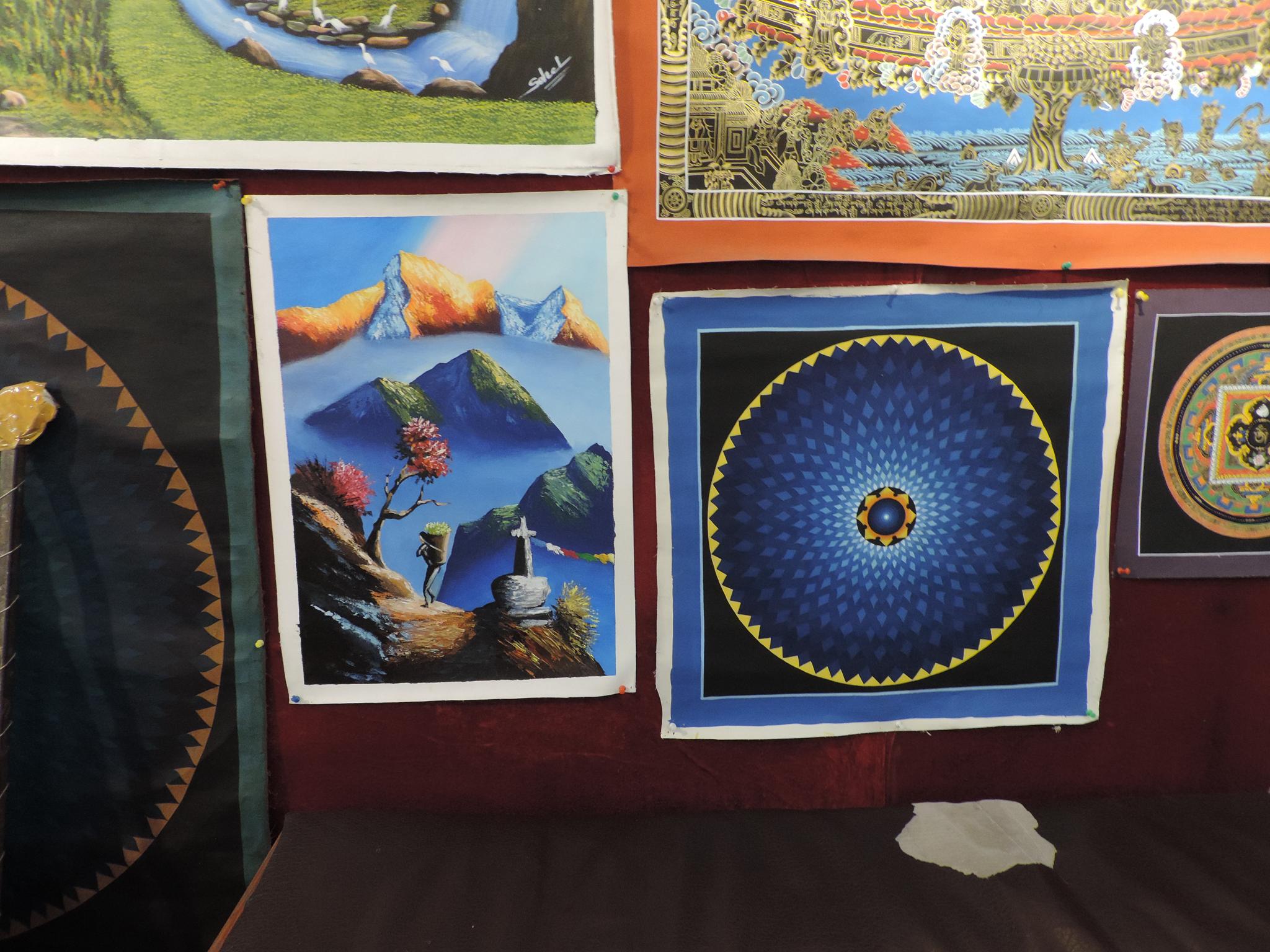
That’s wonderful! And you said it’s the typical animal from here and from the local mountains. So the hair from the Yak is a bit special, and also it is special to make the Thanka. Therefore you need special brushes to make the special Thanka.
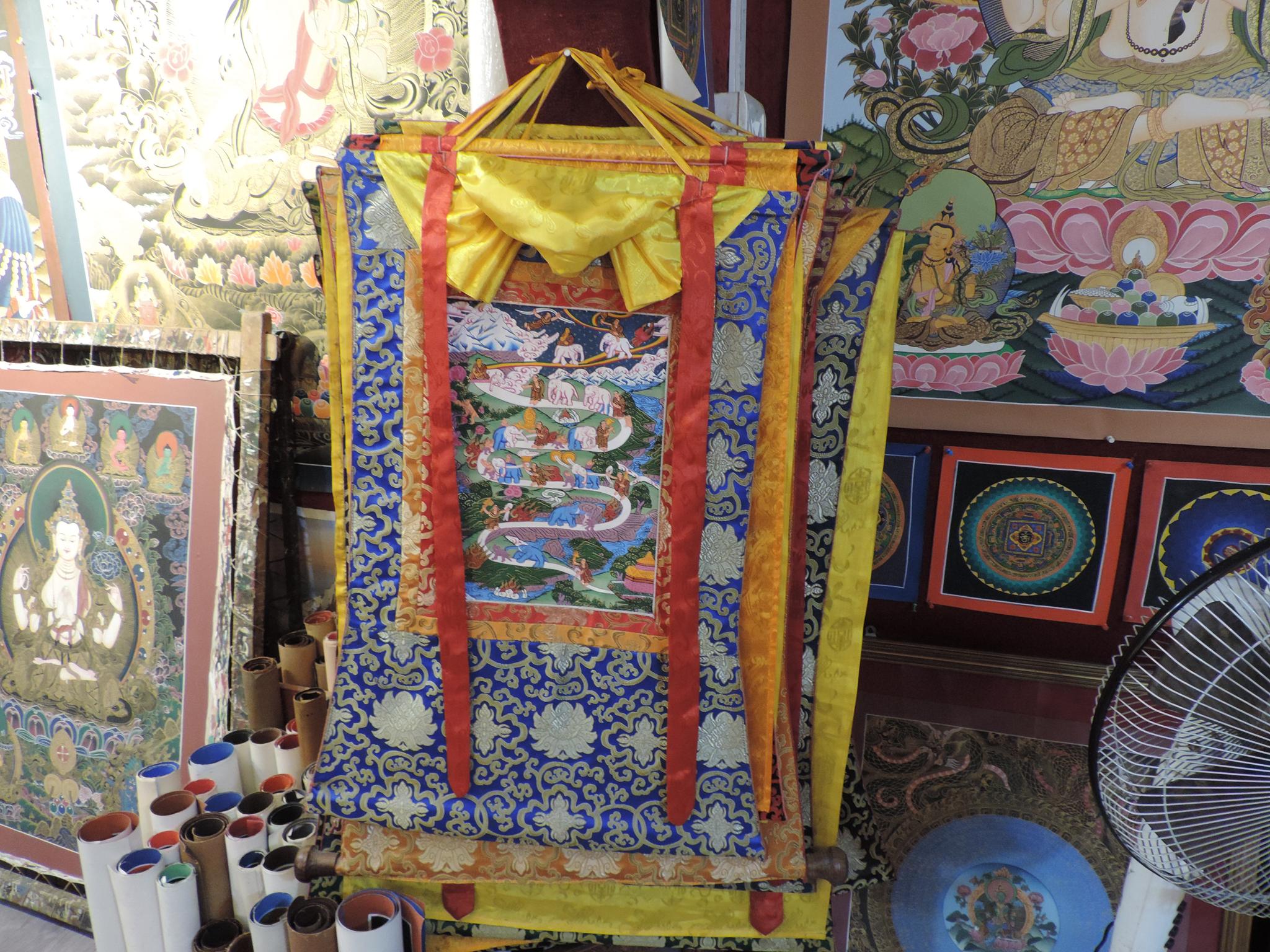
The brush becomes very fine and delicate, and they use it to paint with great precision. It is a very special instrument, better than other types of brushes. This is a traditional art, and there are many different types of designs. In the past, there were generally five main designs, including mandalas, the circle of life, Kalachakra mandalas, and individual figures. Nowadays, artists create more and more designs. Originally, artists painted more individually, but as the art became commercialized, they began to produce more designs and include them in their work. This is how it has evolved over time.
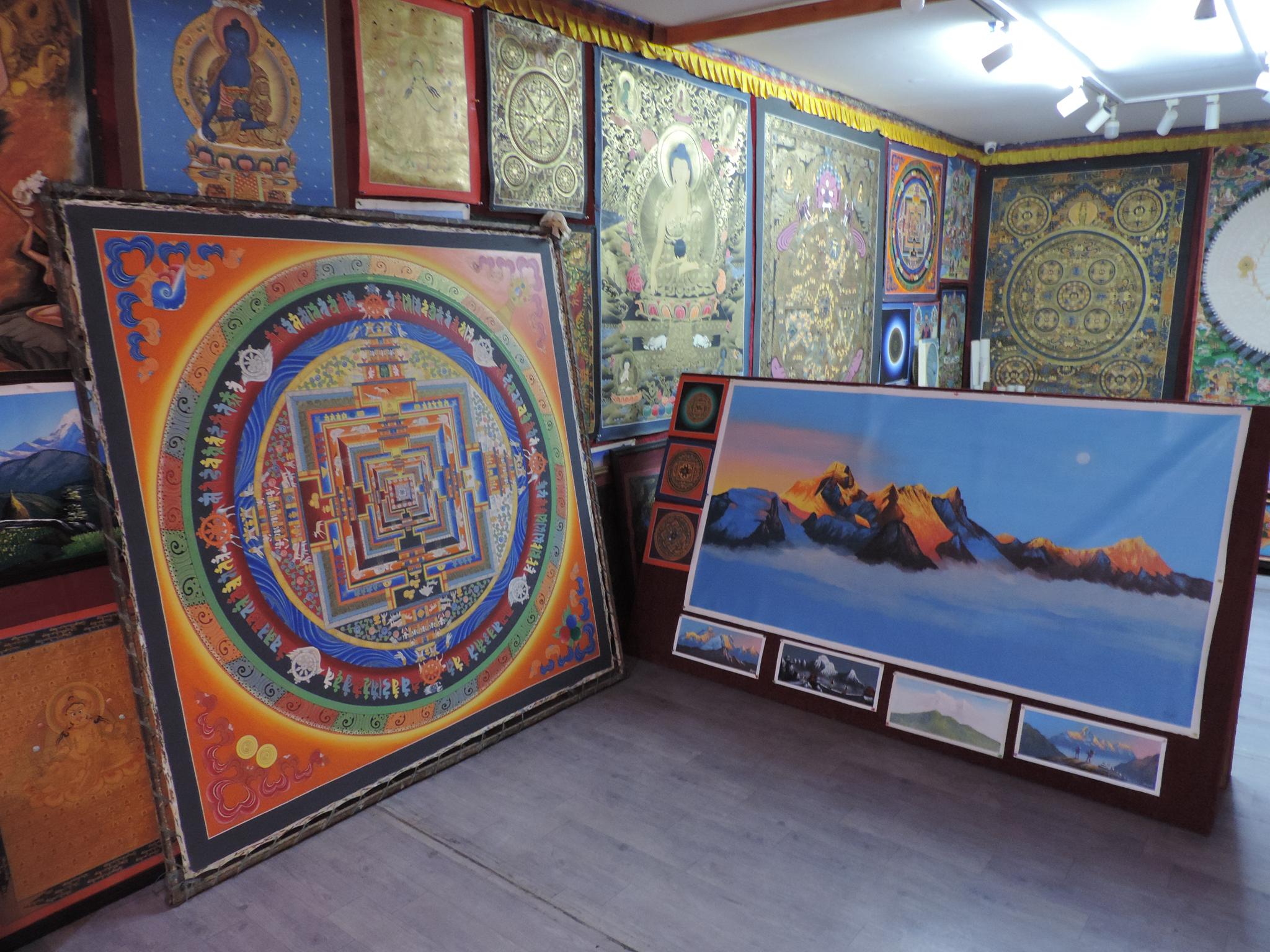
When I look around, I can see that there are many different styles. This means there is a basic structure for creating a mandala, but each artist brings in their own individual style. Some use more traditional motifs, others make it more graphical, and some incorporate modern abstract elements. As a result, mandalas can turn out in many different ways. Tell us some more words about that, for example with this artwork.
This is the College of the Mandala, also called the Wheel of Time. It was originally designed by the Dalai Lama. When he traveled to different countries, he collected various colors of sand and used them to create these designs on the floor. After completing them, he would destroy the design and pour the sand into a river, symbolizing that nothing in life is permanent. In the center, there is a flower structure, most likely a lotus, representing nirvana, which signifies ultimate peace and happiness. To reach nirvana, you go through six elements: wisdom, space, air, fire, water, and earth. There are also three doors: the body door, the speech door, and the mind door. After passing through these, you can reach nirvana. You can also see four different dimensions, representing different times of day: night, morning, afternoon, and evening. If you focus on the center, you can see a pyramid forming in three dimensions.
This reminds me to some monks, they spent like weeks or even month to make a huge mandala on the floor with sand. And then when it’s finished, they just destroy it and swipe it away. But it’s about the process and the creating, to be in the moment of doing something. And the result is actually unimportant.
Yes, you are right. Also these pieces are mainly created on full moon nights. When they are worshipped, people use the mandala to pray to the Buddha. The design is very beautiful, and the golden surroundings are incredibly detailed. The structure is very tiny, so it takes a long time to create it precisely.
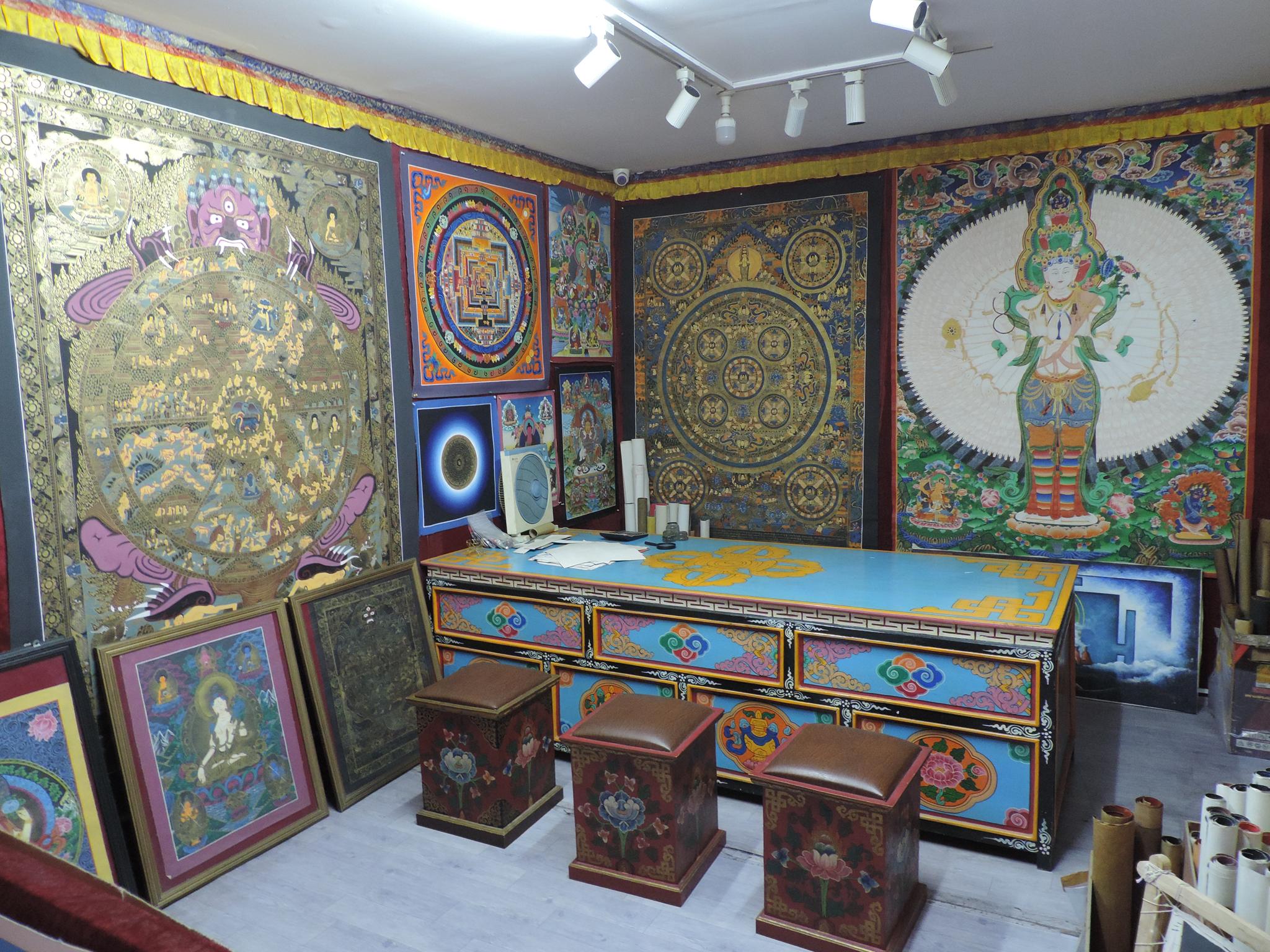
Are the finished paintings around here also made by people who studied here?
No, not from the students. Those take more time. What you see here are all the masters‘ works. They were all created by the masters. If you are looking for student work, it is simpler and smaller. Student pieces are usually done with acrylic paints, while these are made with mineral pigments.
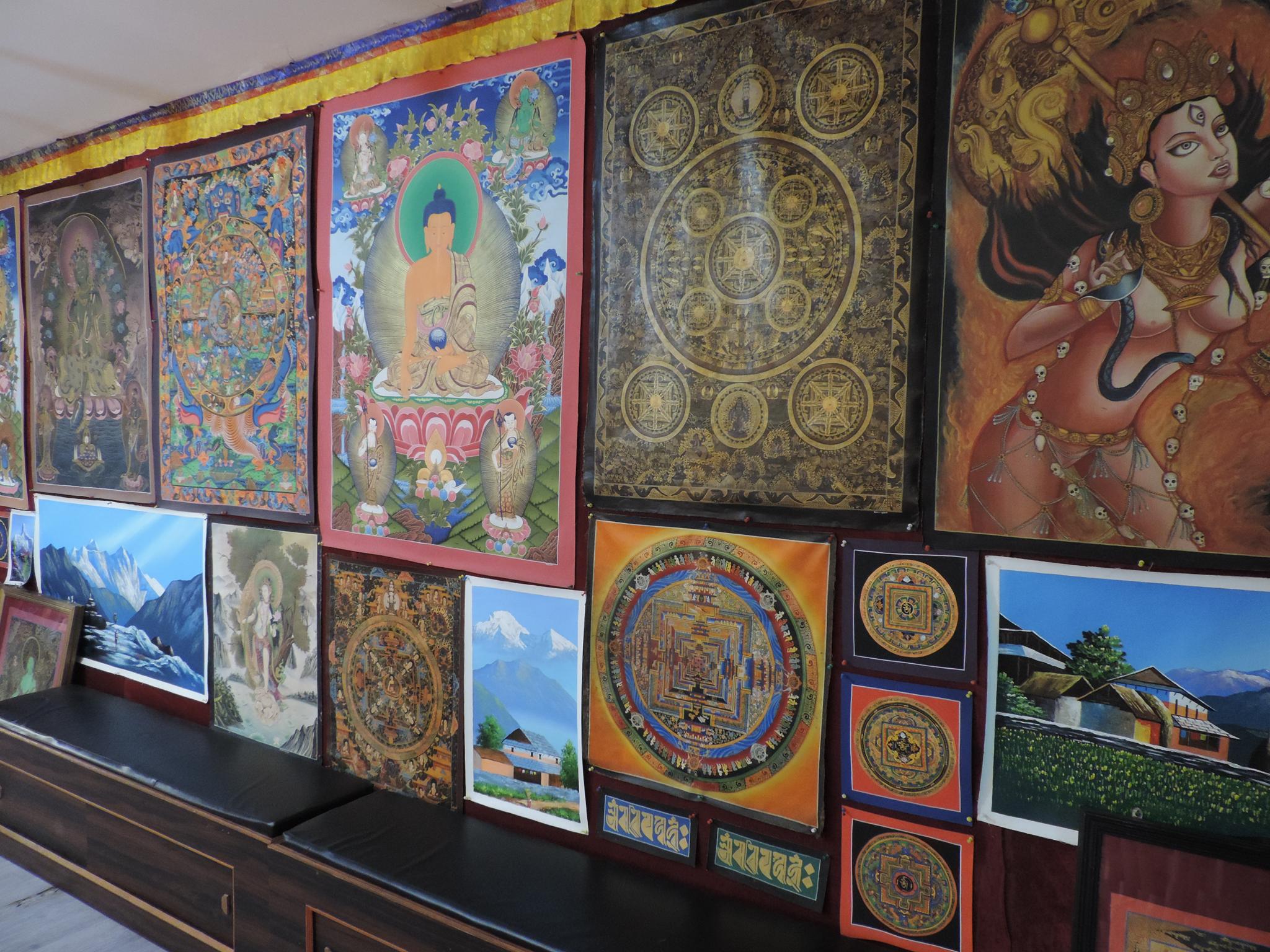
So here we have one of your works, a very nice round mandala with your style and interpretation. How long did it take you to make this?
It took me around three days. But not full-time painting. But if you make it bigger or with more details, it can easily take you one week.
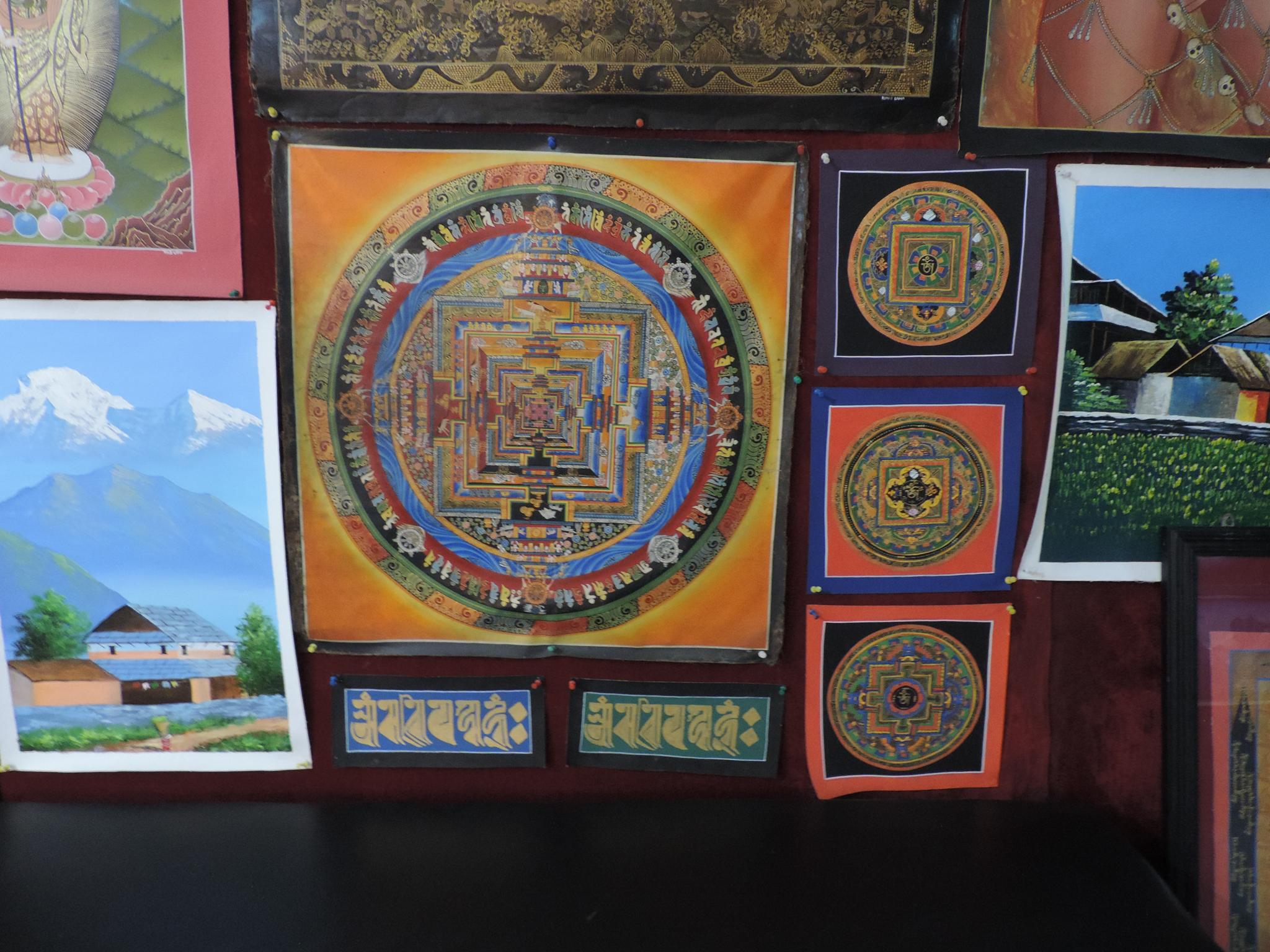
Like with the art students, for example, if tourists come here and maybe they stay a bit longer, do you also make one-time-workshops or something like that? And can they also make art lessons like for two weeks or a month?
Yes, of course. We can make everything. We can make workshops for one occasion or in many different ways. Many people are now having workshops, so of course we provide that as well. This can start with an one hour short intro, up to whatever they want. If people are interested in those topics, just contact us.
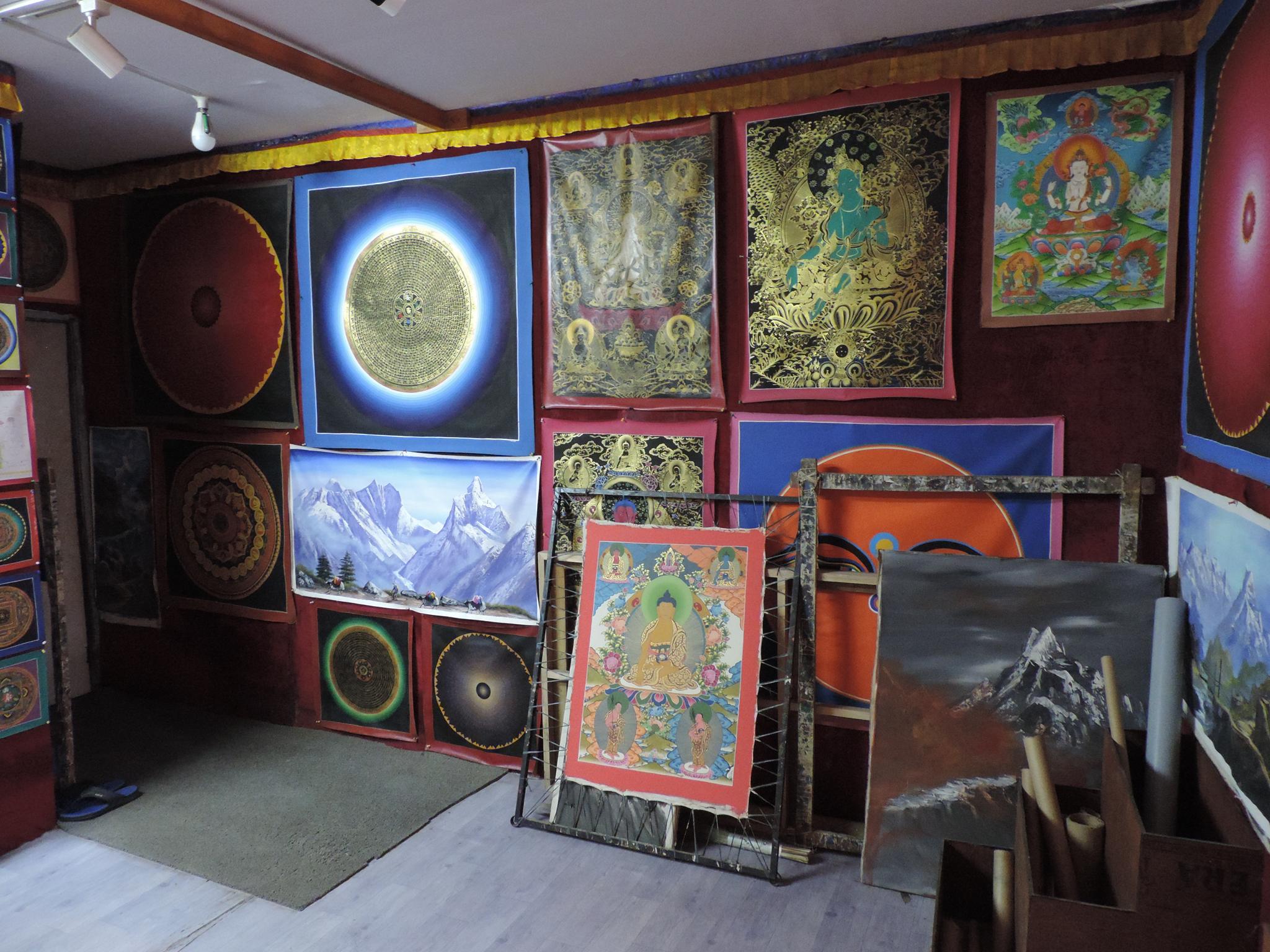
Wow, this is awesome what you are showing us now. What is that?
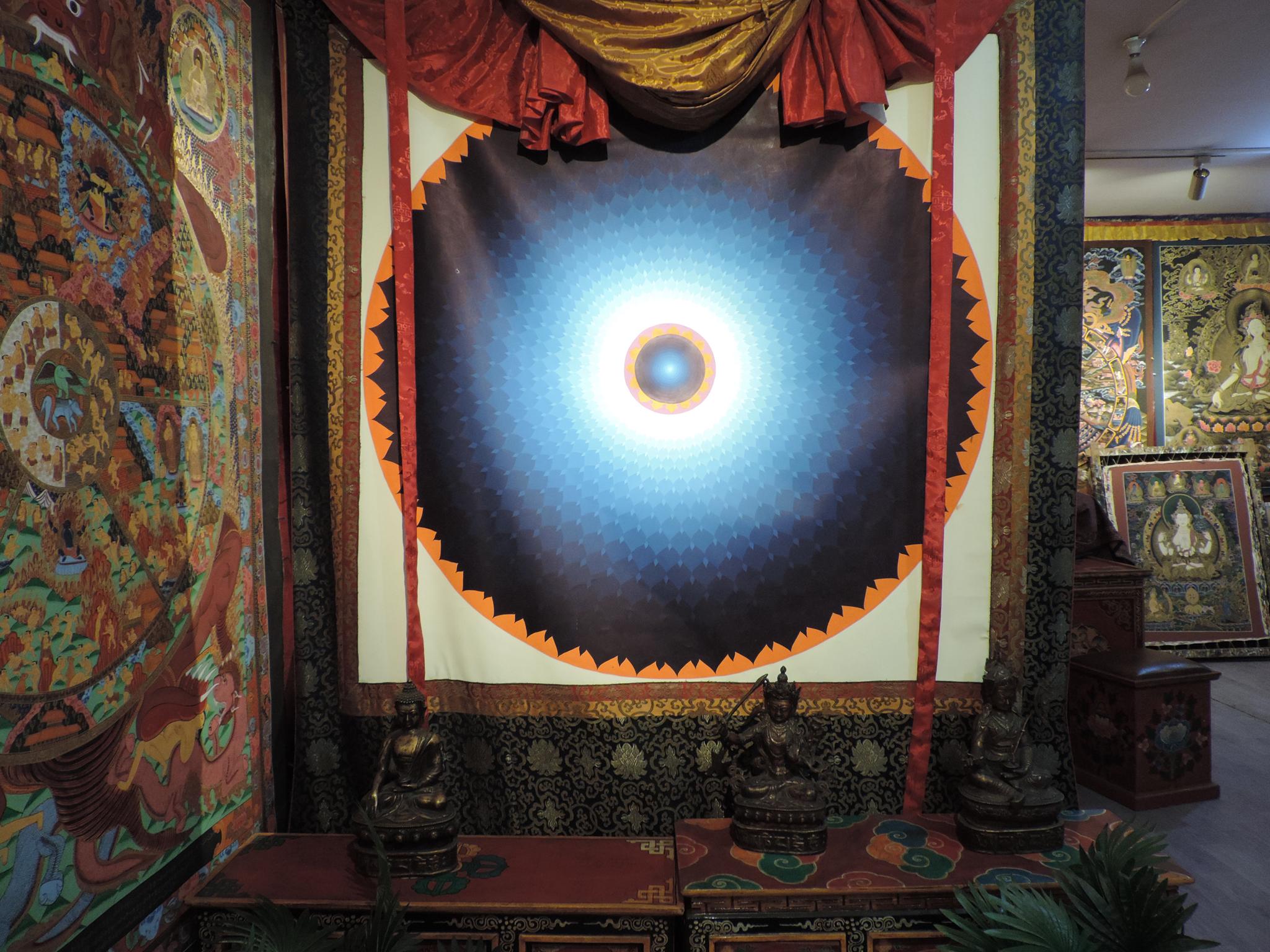
This is one version of the traditional mandala firstly designed by Buddha himself 2500 years ago. The real meaning of a mandala is always a circle which is more geographic and geometric. And it’s a representation of the universe. Every mandala there is like a nirvana in the middle. So if you look up in the upper part, there is the god with thousands of arms and heads. That is the god of compassion. And if you go in the downside, there is the god Yama.
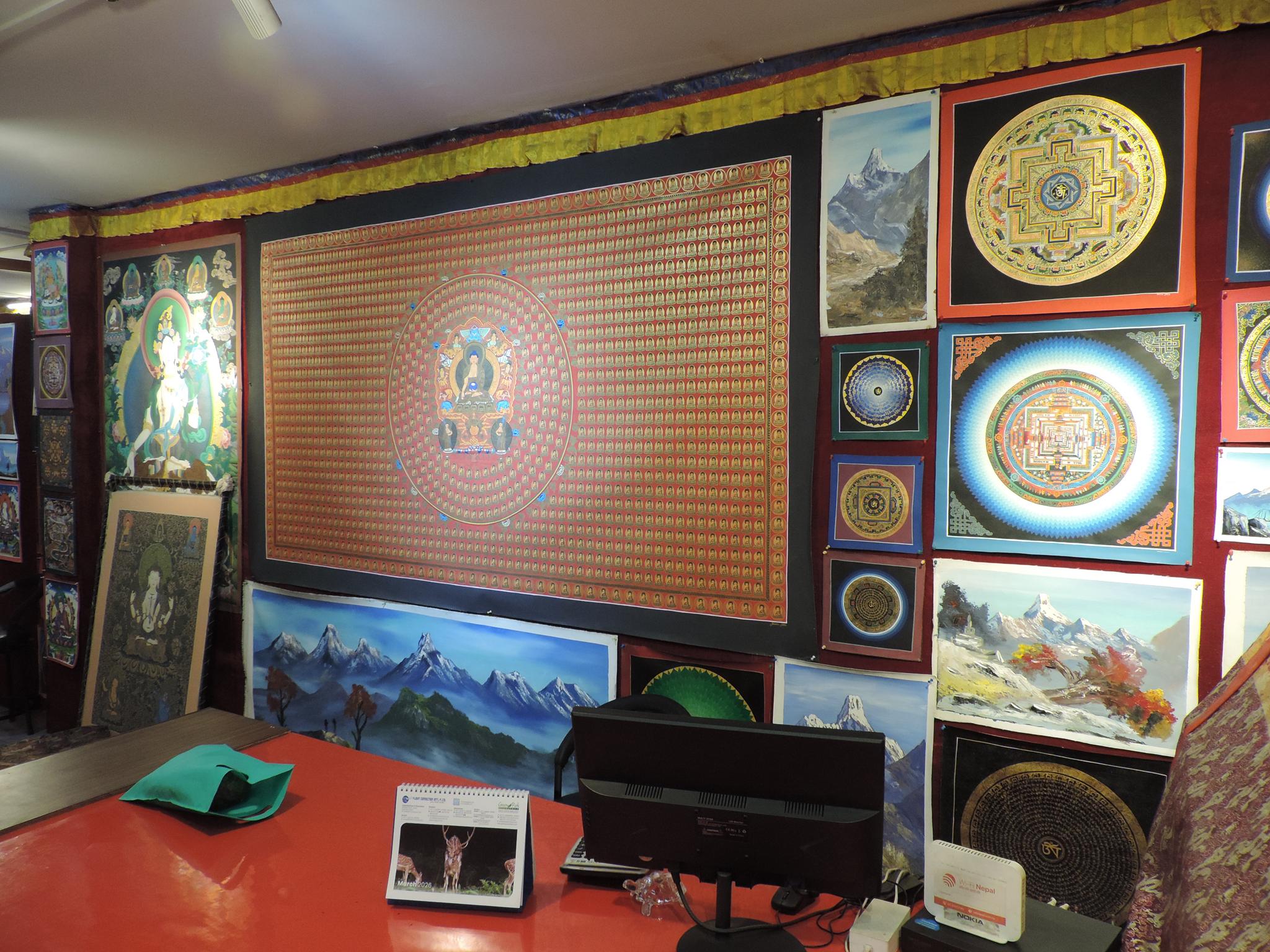
Everywhere you look around here, there is something amazing; it is a very great artwork, especially the ones where a lot of gold is used.
Yes, there are two kinds of gold. There is 18 karat and 24 karat, and sometimes paste gold is used. Paste gold is applied using the finest technique, while the middle masters use 18 karat, and the highest quality artworks are done with 24 karat gold. We also have pieces like the Court with the Three Eyes, which represents life and love.
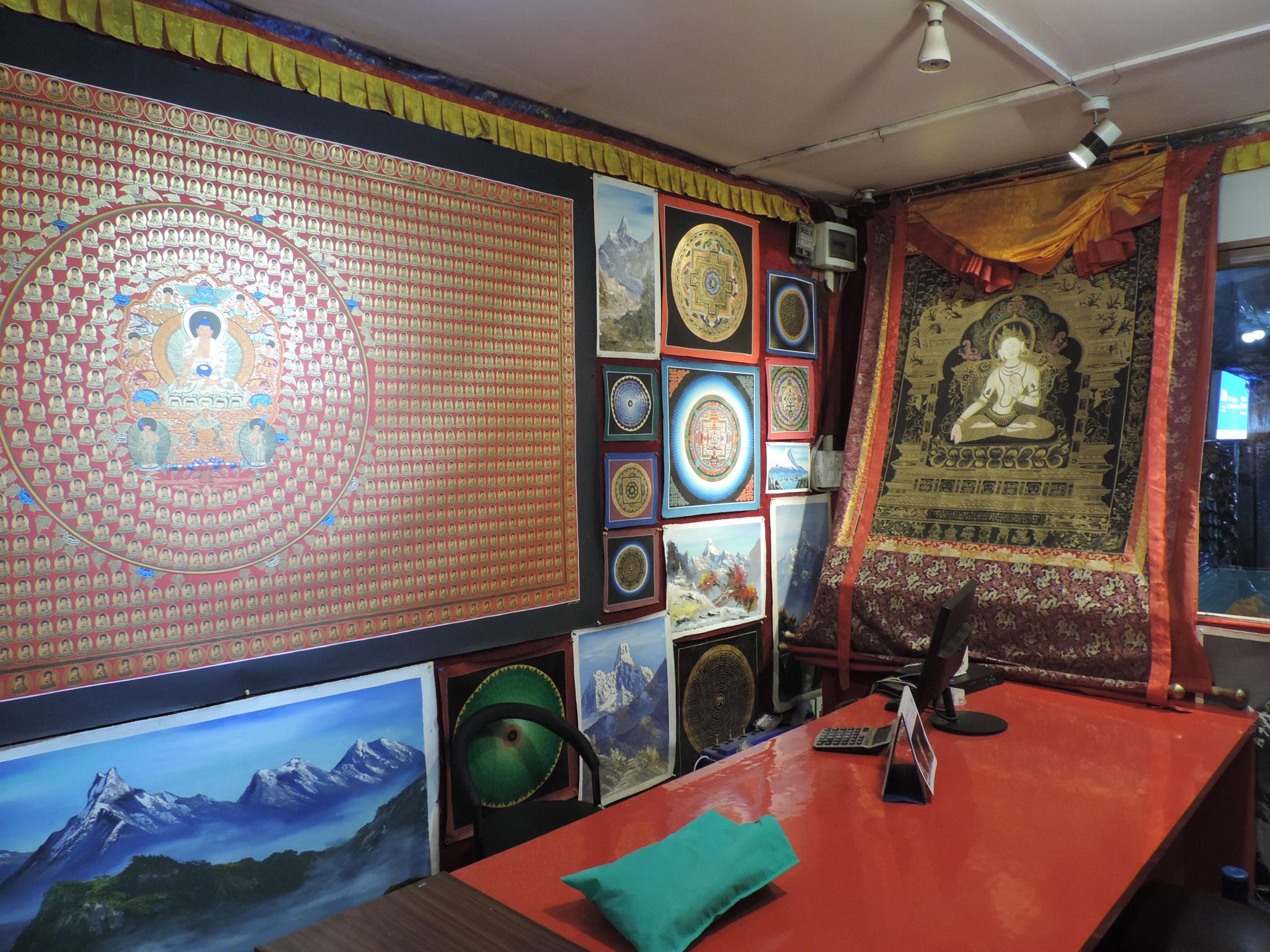
In this circle, I see stages and different realms. Can you explain them?
In this circle, there are two stages, and inside there are six realms. The three lower realms represent hell, and the three upper realms represent heaven. In hell, you can see animal life, hungry ghosts, and the actual hell where suffering occurs. In heaven, you can see human life, demi-gods, and gods. The reason behind all suffering is indicated in the middle by a pig, a snake, and a cock. The pig represents ignorance, the snake anger, and the cock desire. Only by removing these three from our minds can we reach nirvana and escape this circle. Yama, the god of death and justice, holds the circle and decides whether a person will go down to hell or up to heaven according to their karma.
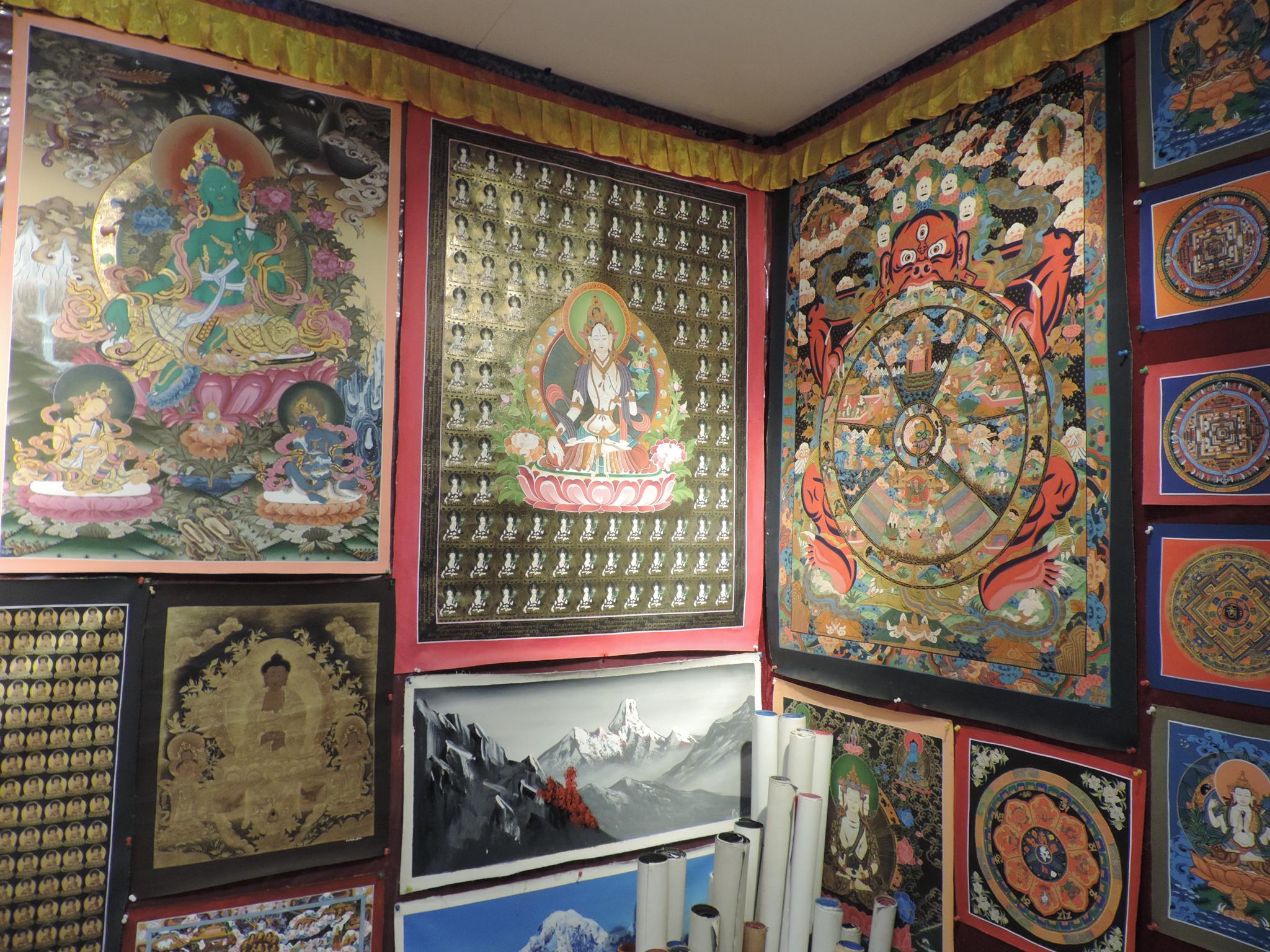
Some of the artworks you showed me before, like those with gates, are they more Buddhist, or a mix?
Some are more Buddhist, while others mix Hindu and Buddhist elements.
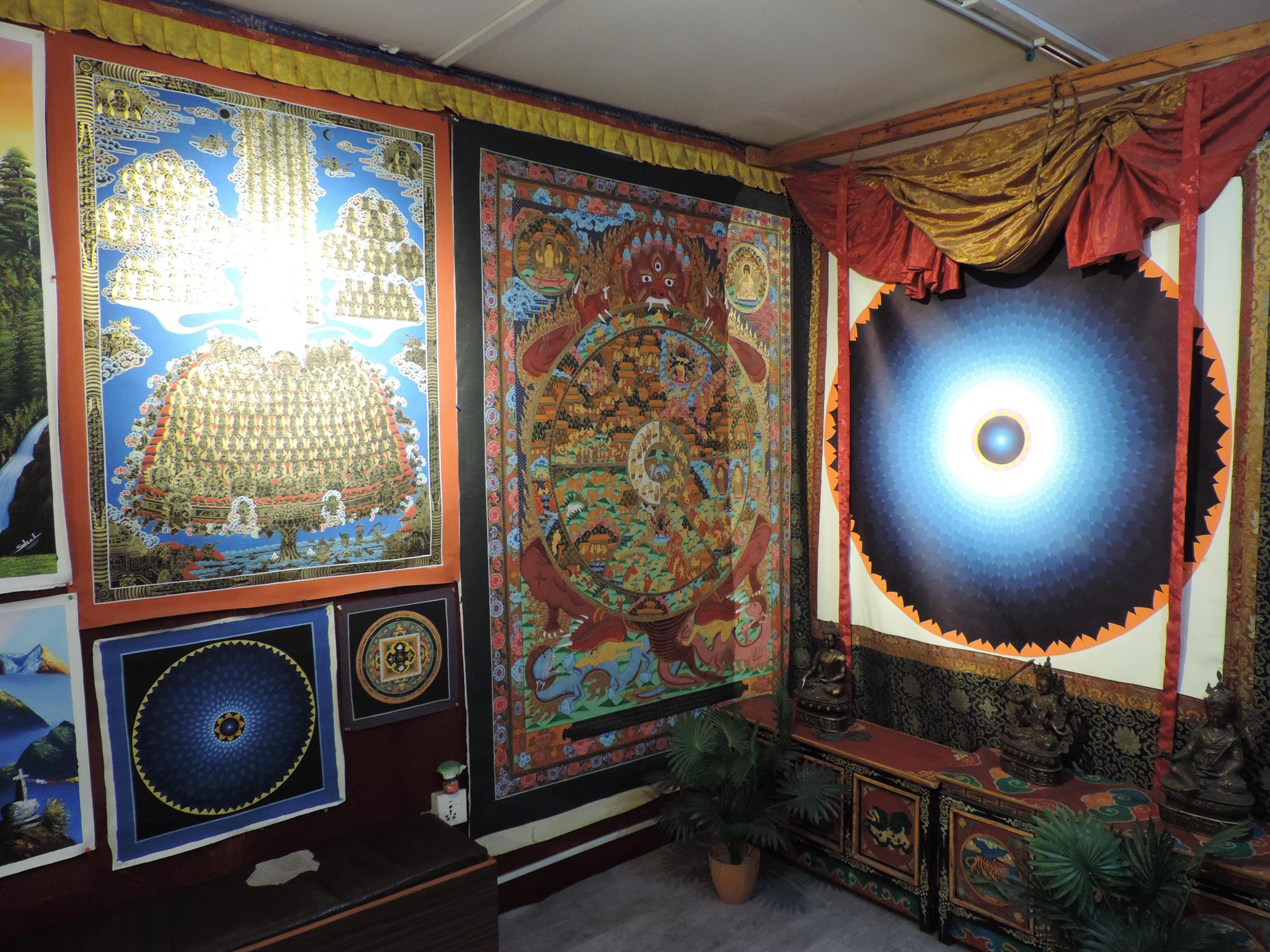
So you have some paintings that are fully Hindu, some fully Buddhist, and some are a mix of both?
Yes, exactly. And that mixture ideas are the very developing part.
For foreigners or tourists who are trekking or climbing and do not have a big backpack, can you ship or send artworks to other countries?
Yes, of course, we also offer shipping. If someone is going on a trek and cannot carry a painting, they can make a reservation here. We write their name on the back of the painting or on the roll, store it safely, and when they return, they can pick it up and pay any remaining balance.
That is very convenient. Tell us more about the network of your organization and the your creative projects.
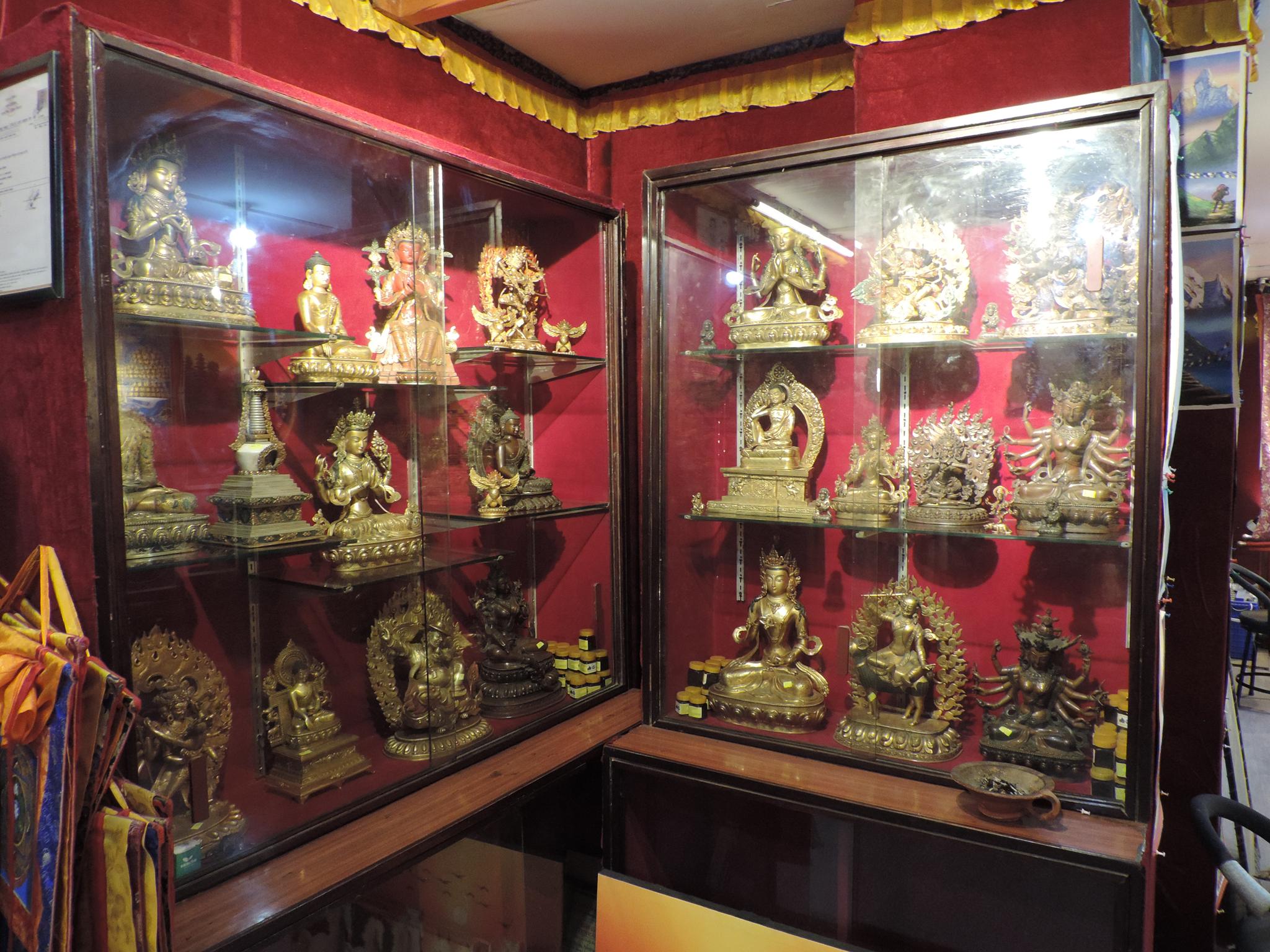
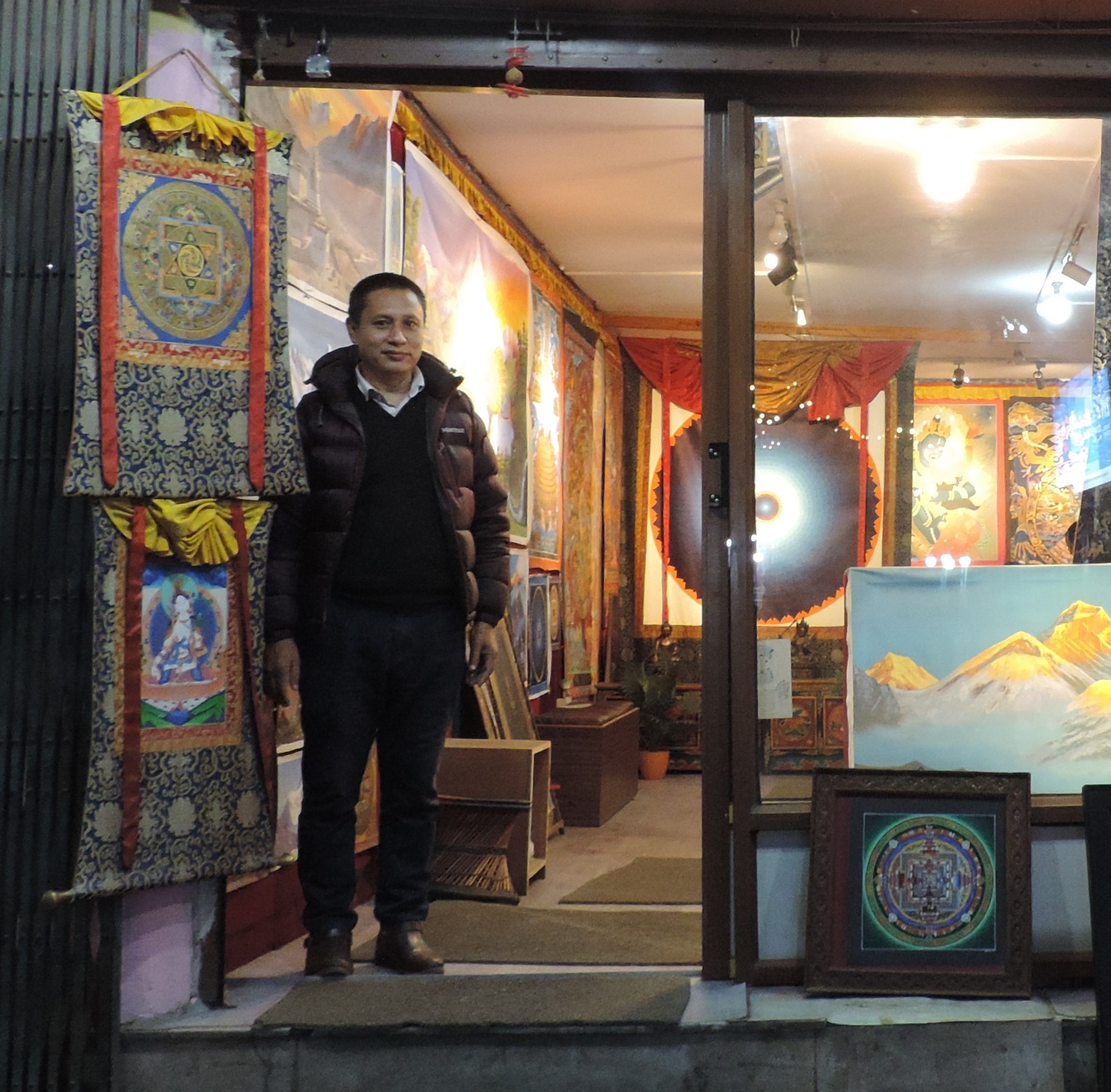
This whole idea what we do is full of colors everywhere. In Kathmandu, in Central Thamel, we have a school, which is ours, though some people have opened schools after learning from us. What we have here is a large cooperative of art, connected to over 10.000 artists. We are from the eastern part of Nepal, called Rameshap, where many artists live and paint this kind of art. The cooperative brings them together. This makes us not only artists and an art school but also collectors. The cooperative has thousands of pieces contributed by individual artists. Guests from different countries can visit, view the art, and buy pieces, and the proceeds support the school and the artists here.
That is impressive. So in some way, you started to connect and bring all the artists together to support each other?
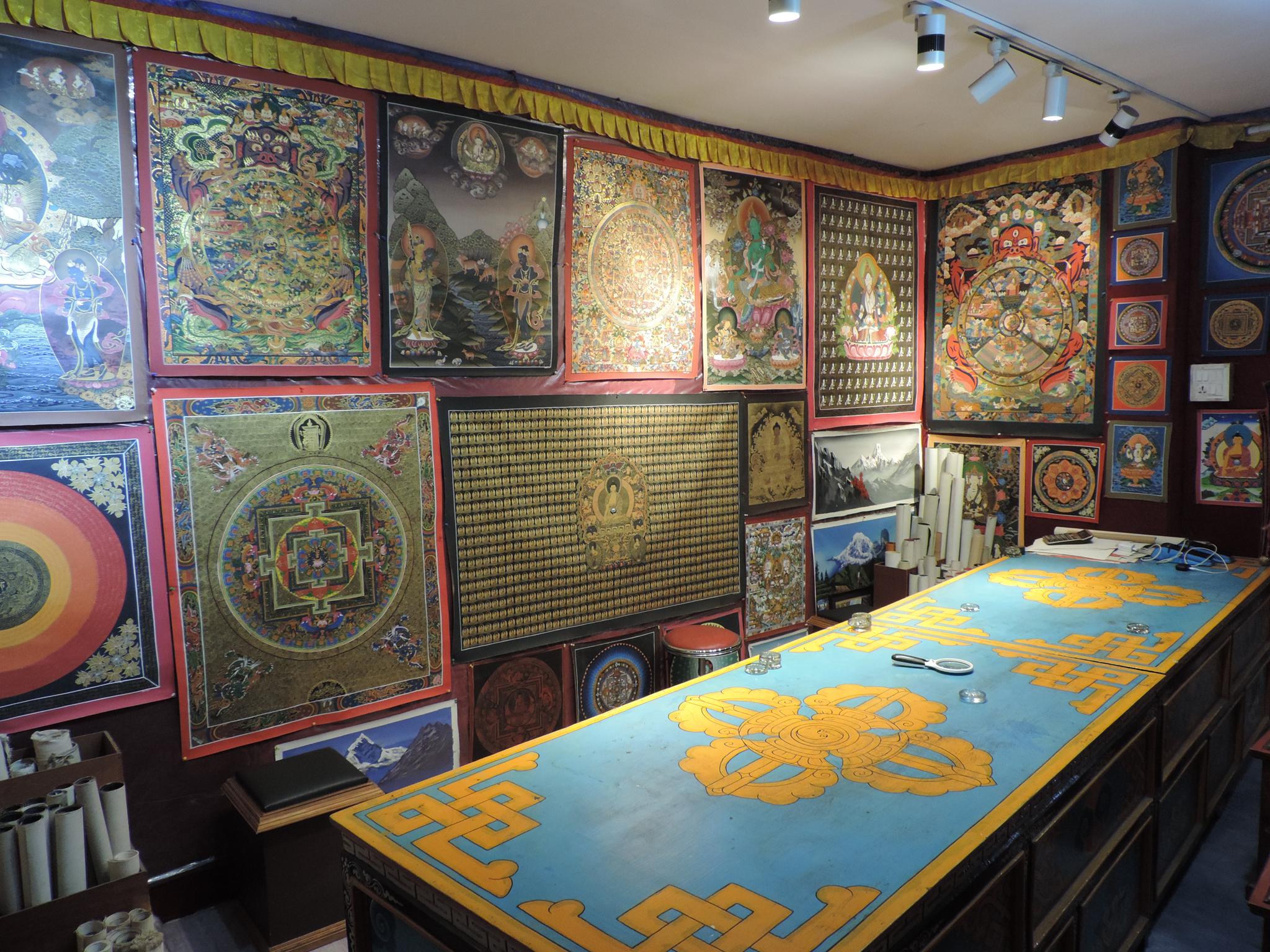
Yes, that was and is the plan. And we support each other like that. We are a very small family. It is not only about art; it is also part of Nepali culture, tradition, and history. Even the tables here are painted. Tables are different, and we paint not only on canvas but also on wood. Some paintings in this place are more than 200 or 300 years old, coming from monasteries, forming an antique collection.
So the word monastery, is it connected to a real monastery?
Yes, a real monastery. This is why it became a world monastery. But not this building here. There is an original monastery. But here we live in a rented place. But all of this is part of the monastery in the countryside, about two days’ walk from here.
So there is a very deep connection between art and religion.
Yes, this is a non-forfeitable organization. Art itself is very hard to leave. If someone buys a piece, it supports not only our single space but also the schools and the art cooperative in general. People can come here to learn, and we can teach them. We hope many people want to know more all of this and maybe also want to buy some of our artworks. Visitors can also learn to paint here; even in one hour, they can be able to create a small mandala themselves. Just contact us via email or step by when you are around Thamel.
INFOTHEK
 Art School, Art Gallery & Creative Space: OLD MONASTERY THANKA AND ART PAINTING SCHOOL
 Location: Saat Ghumti Marg – GPS: P886+769
 Phone: +977 9841257598 – +977 9808817418
 Email: kumarlama70@hotmail.com – tamangkusphu@gmail.com
 Facebook: https://www.facebook.com/oldmonasterythanka
MORE ARTICLES ABOUT NEPAL
>>> Thanka Arts School – Kumar Lama <<<
>>> Lalitpur – Mitra Graffiti Wall <<<
>>> Kathmandu – Snooker Graffiti Wall <<<
>>> Streetart Festival Bharatpur <<<
>>> Bharatpur – Graffiti & Urban Art <<<
>>> Pokhara – Rolling Stones Graffiti <<<
>>> Dasarath Rangasala Mural Wall <<<
>>> Dharahara Concept Wall <<<
>>> Sauraha – Chitwan Streetart <<<
>>> Sanepa – Streetart & Graffiti <<<
>>> Boudha – Streetart & Graffiti <<<
>>> Kupondole – Streetart & Graffiti <<<
>>> Thapathali – Streetart & Graffiti <<<
>>> Indra Chowk – Streetart & Graffiti <<<
>>> Amrit Marg Graffiti Wall <<<
>>> Thamel – Streetart & Characters <<<
>>> Thamel – Graffiti & Styles <<<
>>> Thamel – Throw Ups & Bombings <<<
>>> Thamel – Tags & Signatures <<<
>>> Painted Shop Shutter Collection <<<
>>> Colorful Tiles Collection <<<
>>> Creative Vehicles Collection <<<
>>> Kupondole – Architecture <<<
>>> Bharatpur – Architecture <<<
>>> Wax & Wick Candles <<<
>>> Suresh Gandhari – Sarangi <<<